

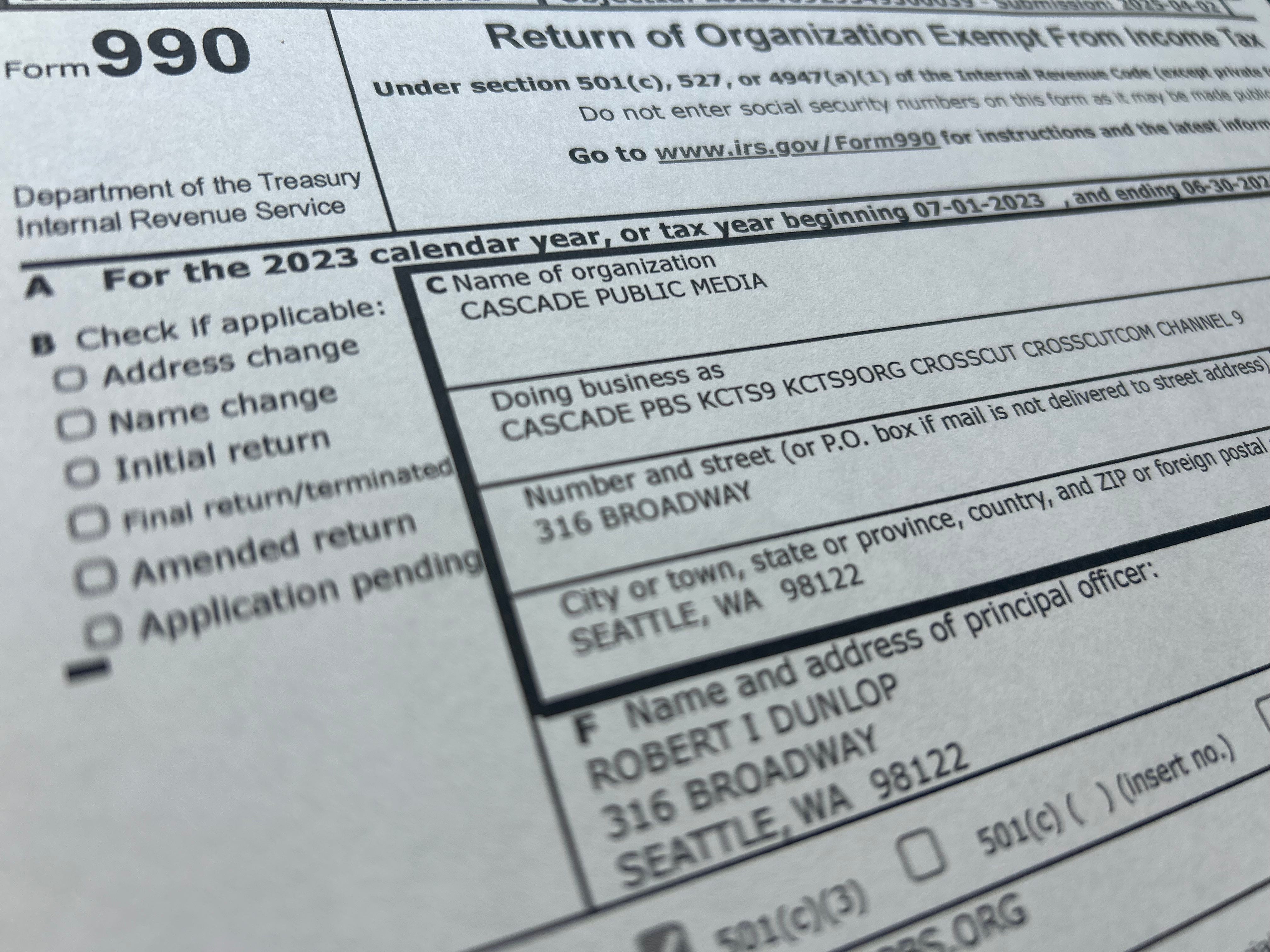
Cascade PBS, the public broadcasting affiliate in greater Seattle, announced the termination of its Crosscut news division on September 22, citing a $3.5 million federal funding loss.
The operation will cease on October 31.
But could Cascade PBS – or, for that matter, any of the major-market public broadcasters that have made similar announcements threatening to end local programming – simply be looking for a way to crank up the fundraising machine?
Worth thinking about, for sure.
The timing aligns conveniently with predictable fundraising narratives about federal funding threats in the philanthropic playbook for 2025: Blame everything that is wrong with my street, my city, my county, my state, my country and my world on the federal government, President Trump’s administration, and their policy plans.
Not sure this is a hot take or that I intend it to be, but, right now, it’s really easy to make difficult decisions more palatable to 50% of the general public if you blame the Trump administration for everything that’s wrong. And, in this case, it probably will be effective in improving local giving. Because not too many people actually take the time to read a 990 filing document and far fewer have ever heard of one.
I, however, did look into the numbers.
The Corporation for Public Broadcasting stares at a $1.1 billion hole in federal funding, and that trickles down to local markets. As I am sure you have seen or heard for yourself if you’ve watched more than 10 minutes of your local Public Broadcasting System station or made it to a station break on your local National Public Radio operation, the desperate pleas to raise money locally are among their demands.
Meanwhile, the national players at the table – Corporation of Public Broadcasting, the Public Broadcasting System, and National Public Radio – are fighting among themselves in the courts over a $57.9 million grant for satellite systems.
What gets lost in the entire discussion of public media is simply how much money there is washing through the 1,500 PBS and NPR stations.
In straight CPA terminology: There is a ton. It’s an industry measured in billions of dollars.
Roll it all up, and CPB, PBS, and NPR and the rest of public media had pulled in somewhere in the ballpark of $4.5 billion last year from all sources before the federal government determined that it wasn’t interested in participating further.
A review of Cascade PBS’s financials suggests cutting Crosscut was a choice rather than a necessity.
Cascade PBS’s Form 990 filings and audited consolidated financial statements for fiscal years ending June 30, 2022, 2023, and 2024 indicate steady growth in net assets and stable liquidity. Data is drawn directly from those 990 summaries, organization-published 990s, and independent audits.
For Fiscal Year 2024, total support and revenue for Cascade PBS was more than $46 million ($46,368,144), primarily from contributions, grants, and memberships. Total expenses were $31 million ($31,054,080), and focused on program services (approximately 68%).
This resulted in a change in net assets of $15+ million. Year-end cash and cash equivalents stood at $10,035,580, with total assets of $120,271,097 and liabilities of $24,502,315, yielding net assets of $95,768,782 ($68,180,269 unrestricted, $27,588,513 restricted).
Forgive the dense math lesson, but for those of you not familiar with reading the 990s of media companies: this is a better financial situation than most others.
Liquidity remains adequate, with reserves covering six months of operating expenses and $21,547,054 in financial assets available within one year.
Trending over three years shows the following:
Cash and cash equivalents: $10,845,616 (2022), $13,152,368 (2023), $10,035,580 (2024)—a peak in 2023 followed by a modest decline.
Total assets: $89,280,718 (2022), $106,113,292 (2023), $120,271,097 (2024).
Total liabilities: $22,947,876 (2022), $25,413,402 (2023), $24,502,315 (2024).
Net assets: $66,332,842 (2022), $80,699,890 (2023), $95,768,782 (2024).
Revenue: $33,514,267 (2022), $41,898,090 (2023), $46,368,144 (2024).
Expenses: $25,051,323 (2022), $27,390,728 (2023), $31,054,080 (2024).
Change in net assets: $8,462,944 (2022), $14,367,048 (2023), $15,068,892 (2024).
The organization maintains a $2 million line of credit for potential needs. Reserves ranged from three to six months across years. Contributions drive revenue (80–87%), with expenses weighted toward programs and salaries.
The numbers are instructive. Cascade PBS operated on a $42 million annual budget in 2024 and achieved an $11 million revenue surplus. The federal cut represents 8.3% of total budget—significant, but hardly catastrophic for an organization with a 26% revenue surplus.
Private data is not available for corporations, but running news operations for media companies over the span of 20+ years, I would bet dollars to donuts that no other Seattle-based news-media operation ran at a 26% margin in 2024. Those kinds of numbers in local commercial media are as dead as the Dodo bird.
Executive Compensation vs. News Operations
According to Cascade PBS’s fiscal year 2024 IRS filing, the nine-member executive team collectively earned more than $2.2 million. Management announced no executive pay cuts would accompany the newsroom elimination.
Crosscut was composed of 19 positions, 16 filled. Using the recently negotiated union minimum of $70,000 annually, the entire newsroom payroll approximated $1.33 million— or a little more than half of executive compensation.
Simple arithmetic: A 20% reduction in executive compensation would have saved $440,000. Combined with the “hundreds of thousands of dollars” in crisis donations received after the federal funding announcement, if Cascade PBS actually wanted to keep Crosscut, it could have.
Timing matters in business decisions. Cascade PBS eliminated the newsroom months after staff finalized their first union contract, securing $67,000 starting salaries and $70,000 minimums for all members.
Revenue Realities
The federal loss of $3.5 million is real. So is the operating surplus. So are the crisis donations that poured in when the public learned of the existential threat to local journalism – and democracy.
Consider the operational efficiency question: How does a public media organization with a 26% revenue surplus determine that an 8.3% budget reduction necessitates eliminating an entire division? Private sector media companies routinely operate on margins below 10%. Cascade PBS’s margin exceeds most Fortune 500 companies.
Within that lies the real problem with what’s been happening with public media companies. Like universities sitting on massive endowments that are conveniently tucked away from public eyes and earning massive amounts of interest through strategic investment, there really is no crisis at many public media organizations.
Sure, as Axios reported last month, in smaller public media markets – not only in Washington state, but across the country – there are real issues facing this segment of the media. But there are also local management structures that incur expenses that do not pay for themselves and require subsidy and were designed as such.
There are also organizations such as The Center Square that have reached out to help. In fact, representatives from The Center Square communicated with every single at-risk public radio station in the nation and we have pledged our help in providing the news their markets need to continue to function against the cuts, without any additional expenses to these local stations.
The Replacement Strategy
Rather than across-the-board cuts or fundraising initiatives, Cascade PBS pivoted to video production. The organization will expand existing video series and add three new positions elsewhere while eliminating 19 in news. This isn’t retrenchment—it’s reallocation.
The business logic appears straightforward: Video content aligns with traditional PBS broadcasting. Written journalism, well, it doesn’t fit the model.
The federal cut provided cover for a strategic shift that may have been contemplated regardless, but that again was not part of the contextual disclosure for shuttering the operation at the end of this month.
Comparative Context
Something also to consider, and this is where apples-to-apples comparisons are valuable. Commercial newsrooms operate on far (far, far, far…) tighter margins. I talk to these men and women daily as part of the news service my company provides. A typical metro daily newspaper runs on a single-digit margin, if they have any margin at all. Local-market radio stations in competitive metropolitan markets typically have margins in the teens. Digital news startups often operate at losses for years. Yet Cascade PBS declared written journalism unsustainable after an 8.3% budget impact.
The Center Square operates nationally, publishing an average of 63-plus original stories daily, with zero federal funding. So it can be done. Nonprofit news organizations nationwide demonstrate that written journalism can be sustained through diverse revenue streams when leadership prioritizes it.
Bottom Line
Did Cascade PBS have to kill Crosscut? The financial evidence says no. Alternatives existed.
The decision reflects priorities, not necessities. Cascade PBS prioritized executive retention over newsroom preservation, video content over written investigations, and management preferences over union negotiations.
That’s not a financial crisis. That’s a business decision. And they are perfectly reasonable business decisions.
The question isn’t whether Cascade PBS could afford Crosscut. The numbers prove it could.
The question is why it chose to close.
Perhaps in light of losing federal subsidies, Cascade PBS determined Crosscut to not be all that valuable in the marketplace of ideas.
Thanks for running the mind boggling numbers.
"The decision reflects priorities, not necessities. Cascade PBS prioritized executive retention..."
I cannot name an organization NPO or for profit that does otherwise. Can anybody? The exec are the elite and 99% of them care not about those below them whose job loss often has catastrophic, long lasting effects on them & their families.
I'm a capitalist at heart, but the capitalist execs need a little more heart and perhaps a few a mill or two less (or $70K less each for the Cascade PBS exec team) in compensation.